Google I/O 2026 and Your Loyalty Card: What Actually Changed for Local Shops
A plain read of Google I/O 2026's Wallet announcements for cafés, bakeries, salons and any local shop.
Google I/O happened this week. The coverage is going to be wall-to-wall AI shopping carts, Gemini agents, and futuristic demos that have nothing to do with a café running a stamp card.
So here is the version for shop owners. One thing announced for Google Wallet matters for a local business. A couple of things might matter in narrow cases. The rest you can skip without missing anything.
TL;DR
- •Matters: Google Maps will soon figure out your store locations automatically, so Nearby Passes notifications will work for every location you have - not just the first 10.
- •Might matter: If you take tap-to-pay, Wallet can prompt customers to join your loyalty program right after they pay. Requires Wallet integration at your POS.
- •Background win: The Google Wallet app on Android has a new design. Your card looks better and is easier to find. You don't have to do anything.
- •Skip: Universal Cart, Gemini Spark, the AI shopping stuff. Built for online retailers like Nike and Target. Not for a bakery.
- •Unchanged: Notification frequency limits, what you can offer customers today, how they add a card to their phone.
That's it. The rest of this post is the why behind each line.
The one thing that actually matters: Nearby Passes is getting smarter
Nearby Passes is the feature where a customer's phone surfaces your loyalty card on their lock screen when they walk near your shop. Tap the notification, the card opens, they show it at the counter. No app to open, no scrolling through Wallet.
It has been around for a while. The catch: every merchant could only define up to 10 store locations where the notifications would fire. For a single café, that was fine. For a chain with 15 bakery locations, or a salon group with 12 storefronts, or anyone who opened a second shop and forgot to update their pass settings - it broke quietly.
At I/O 2026 Google announced that the 10-location cap is going away. Google Maps will infer your locations automatically based on your verified business listings. A café group in Lisbon with 14 locations no longer has to pick which 10 to favor. A bakery in Toronto that opens a second location won't have to update anything for Nearby Passes to work at the new spot.
What changes for shop owners: nothing on your end. The work happens on Google's side. The card you already have will start firing notifications at more locations once the rollout reaches your account.
This is what we describe on our home page as location-based pings - cards lighting up on the lock screen when customers walk near your store, turning foot traffic into revenue. The change at I/O makes those pings work for every location you operate, not just ten.
Two caveats worth knowing. First, "soon" in Google announcement language usually means weeks-to-months, not days. Don't expect it to flip on tomorrow. Second, the daily Nearby Passes cap stays at 4 location-based alerts per user per day, across all the passes they have saved. If a customer has three other loyalty cards in their wallet, those are competing with yours for the four slots. Nearby Passes was never a guaranteed-delivery channel and still isn't.
If you want this to work well when it does ship: keep your Google Business Profile accurate. That's the data Maps is reading from. Wrong address, missing locations, duplicates - they will all hurt you. Spend 20 minutes cleaning it up now.
The quiet upgrade: Wallet's Android redesign
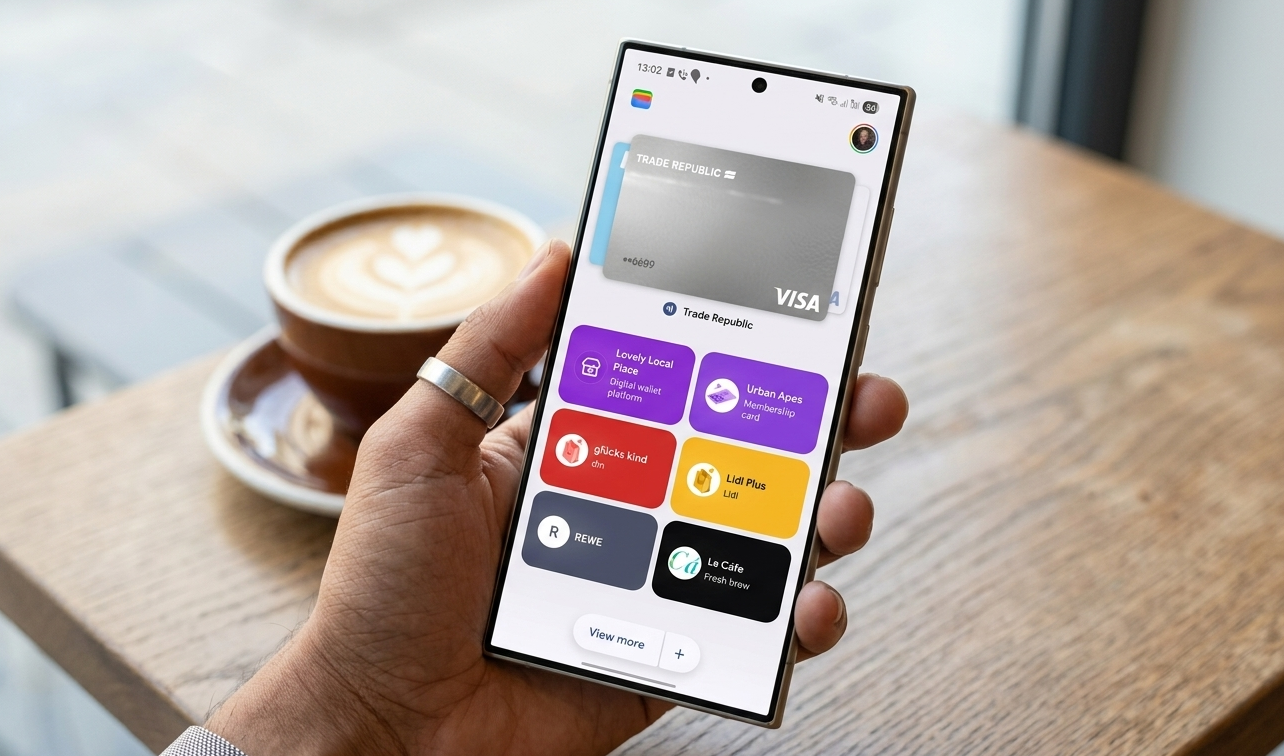
Google didn't make much noise about this at I/O, but the Android Wallet app finished its full redesign and it's now live for all users.
The relevant changes for a shop owner with a card in customers' wallets:
The homepage now puts frequently-used cards at the top. If your customer uses your stamp card often, it surfaces first when they open the app. They scroll less.
Time-sensitive content - boarding passes, event tickets - now takes over the full screen with a fresh visual style. Loyalty cards still look like loyalty cards, which is fine.
A "View more" hub makes everything in the wallet searchable. Customers who have 30 cards saved can actually find yours.
None of this requires anything from you. Your existing card benefits from the new design automatically. It's the kind of upgrade that compounds quietly - when the Wallet app feels better, customers use it more, which means they tap your card more often.
If you take tap-to-pay: contactless loyalty enrollment
This one is narrower but worth flagging. When a customer taps their phone to pay at your terminal, Wallet can now show them a notification afterwards inviting them to join your loyalty program - if you have one wired into Wallet at the POS level.
Who this is for: shops on a payment processor that integrates with Google Wallet's Smart Tap (Square, SumUp, Stripe Terminal, and similar). You also need to have your loyalty program registered with Google as a Wallet-integrated program, not just a digital card you issue separately.
For most local businesses using a third-party loyalty platform that runs alongside their POS rather than inside it, this feature won't be directly available at launch. It's a useful direction, not a useful tool yet.
If you're already on Square and curious whether your terminal supports it: ask your POS provider, not Google. They'll know before Google's docs catch up.
What you can skip
A lot of the I/O 2026 coverage is going to talk about Universal Cart, Universal Commerce Protocol, Gemini Spark, and a parade of AI features that mention Google Wallet by name. Here's the short version:
Universal Cart is an AI shopping cart that lives across Google Search, the Gemini app, YouTube, and Gmail. It's "built on Google Wallet" in the sense that it uses Wallet's payment infrastructure. The launch partners are Nike, Target, Walmart, Sephora, Wayfair, and Shopify sellers. It's for online retail. A bakery does not need to think about this. A salon does not need to think about this. Skip.
Gemini Spark is a personal AI agent for consumers. No merchant tools announced. Skip.
Universal Commerce Protocol (UCP) is the developer standard behind Universal Cart. Same answer. Skip.
Gemini 3.5 Flash, Gemini Omni, Android Halo - these are model and OS announcements, not Wallet features. Whatever they do for you as a consumer, they do not change how your stamp card works.
The framing trick in I/O coverage is that Google mentions Wallet inside every commerce-adjacent announcement, which makes it sound like Wallet itself is changing. It's not. Wallet is the payments rail underneath. Your loyalty card lives in a different part of the building.
What none of this changes
A few things that I/O 2026 did not announce, despite what the hype might suggest:
- •No change to push notification limits. You can still send the same number of updates to your cards as before. No new format. No richer media. Nearby Passes still caps at 4 alerts per user per day across all merchants.
- •No new pass type for local shops. Stamp cards, coupons, and gift cards work the same way they did last week.
- •No AI tools for merchants to design or write cards. All the Gemini features announced are consumer-facing.
- •No pricing change. The Google Wallet API stays free for issuers.
The straight read: I/O 2026 was a big AI conference with a small set of Wallet updates inside it. The Wallet updates that affect a brick-and-mortar shop are real but modest. Anyone telling you that I/O changed the loyalty game for local business is selling something.
What to do between now and rollout
Two things, none urgent.
Clean up your Google Business Profile
Locations, addresses, hours, business category. This is the data Maps will be reading to infer your Nearby Passes locations. Garbage in, garbage out.
Don't wait to start a digital card
Your existing card will get the new Nearby Passes behavior automatically when it ships. If you haven't issued a card yet, every week without one is a week of stamp paper falling out of wallets.
FAQ
The Android Wallet redesign is already live. Nearby Passes location auto-inference is announced as "rolling out" - Google did not give a date. Based on past Wallet rollouts, expect weeks to a few months. Contactless loyalty enrollment is in the same window. The digital receipts API is developer-side and still vague on timing.
Ready to get started?
Set up your first digital loyalty card in minutes. Free to start, no credit card required.