Digital stamp cards for cafés.
Digital stamp cards — or punch cards, depending on where you grew up — built for cafés and coffee shops. Customers save the card to Apple Wallet or Google Wallet. No app to download. No POS to swap out. Live in five minutes.
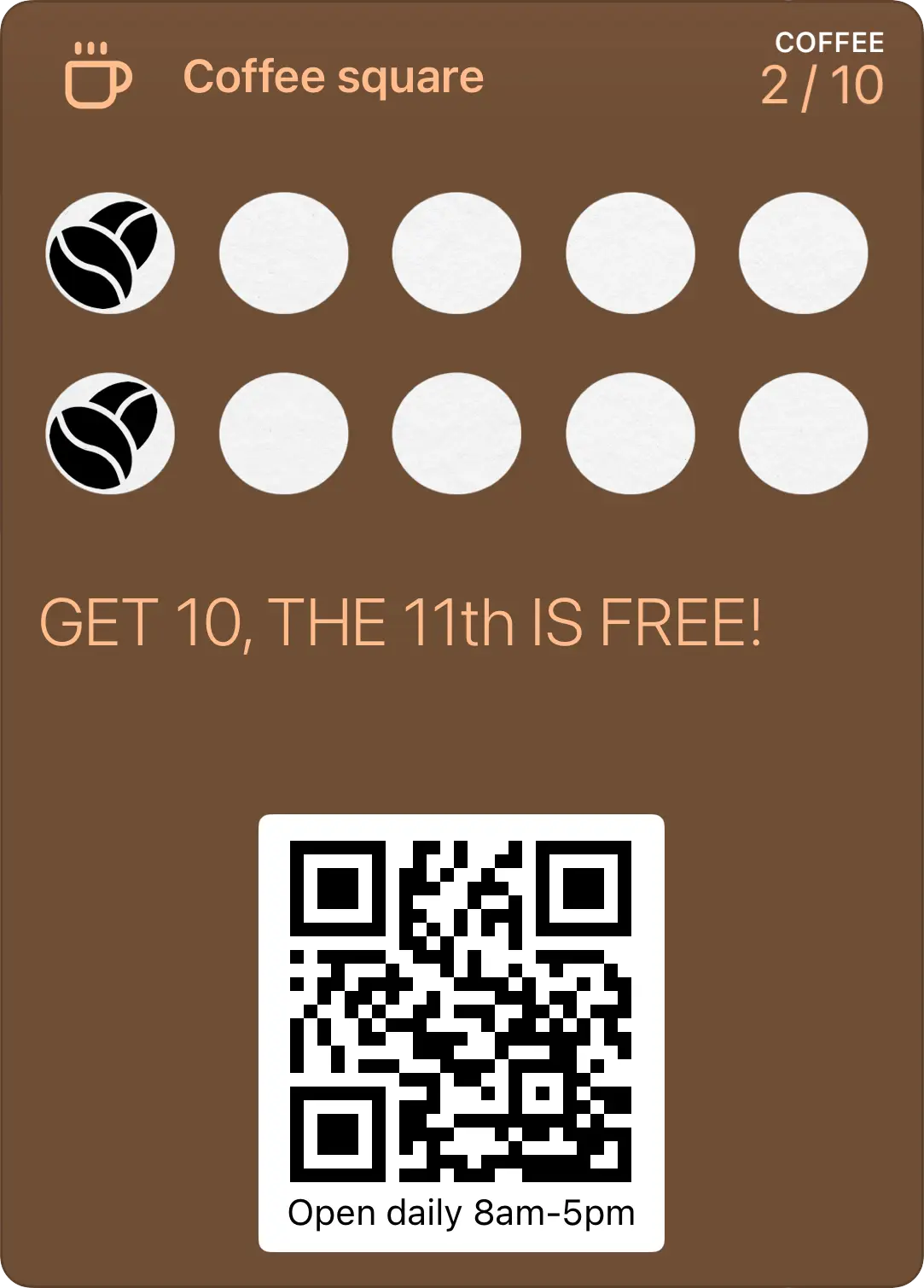


Cafés are textbook stamp card territory.
Three things have to be true. A café is one of the few places where all three are.
Visits are frequent
Three times a week, not three times a year.
The ticket is small
Small enough that the free one feels close, not distant.
The habit is real
Same drink, same counter, before the 9 AM stand-up.
Cafés are the cleanest fit for a stamp card of any local business. The whole model — buy a few, get one free — works because three things have to be true at once, and a café is one of the few places where all three are: visits are frequent, the ticket is small, and the habit is real.
A regular comes in three times a week. The transaction is €4–6. They’re not optimising — they’re on autopilot, looking for the same flat white before the 9 AM stand-up. That’s the stamp card customer. They’ll fill a card in a month without thinking about it. The free coffee at the end is the payoff, but the value to the café isn’t the free coffee — it’s that the customer chose your counter on a morning they could have walked past.
Compare that to a nail salon, where someone comes in every six weeks and the ticket is €60. Stamp cards still work there, but the rhythm is slower and the math is different. Cafés are the textbook case. If you’ve thought about loyalty and not done it, this is the page that explains why now, and how.
Stamp card or punch card — same thing.
A digital stamp card and a digital punch card are the same product, called different things in different places. “Stamp card” is the European and UK term. “Punch card” is the American term — the old cardboard one you punched with a hole-punch tool. The mechanic is identical: collect a fixed number of marks, redeem a reward. Everything below applies regardless of which word you’d use, and we’ll use both throughout.
The buy-9-get-10 model, written for someone who’s run a café.
The classic structure is “buy X, get the next one free,” with most cafés landing somewhere between 8 and 12 stamps. The right number depends on your ticket, your visit frequency, and what you’re giving away.
smaller specialty shops with higher-priced drinks (€6+), customers who come less often than daily, or launch periods where you want the first reward to land fast and create word-of-mouth.
the common default for a €4–5 average drink and a healthy base of three-visit-a-week regulars. The reward feels earned without feeling distant. A typical regular finishes the card in four to six weeks.
bean shops, third-wave places where every drink is a small ritual, or shops with tighter margins where you want the reward to feel like a real milestone rather than a routine payout.
You can change the number from the dashboard later without resetting anyone’s progress, so the call doesn’t have to be perfect — pick something in the range, watch how the first cards fill, adjust if it feels wrong.
What you give away matters less than people think. A 12oz drip is the safe choice — high perceived value, low food cost. A specialty drink is fine too. Free items tend to feel more like a gift than a percentage discount of equivalent value, but discounts work too — if your margins are tight, a “20% off your next drink” reward is easier to absorb than handing over a free coffee. The bigger factor is consistency: the program working the same way every time. (More on stamp card mechanics in the main guide.)
What changes when paper goes digital.
- Customers lose them
- Cards get washed
- The hole-punch goes missing
- Six cards in a bag, none of them yours
- New baristas don’t know the rules
- You have no idea who’s coming back
- Lives in Apple / Google Wallet
- Boarding-pass territory — never lost
- Nothing to download
- Always with the customer’s phone
- Visit frequency in your dashboard
- Message the ones who've gone quiet
Paper punch cards work. The reason most cafés have a stack of them somewhere in a drawer is that they delivered for years. The reason most cafés stopped using them is what happens after: customers lose them. Cards get washed. The hole-punch goes missing. A regular has six different café cards in their bag and forgets which is yours. A new barista doesn’t know the rules. And you have no idea who’s coming back, how often, or whether the program is doing anything for revenue.
Digital fixes those leaks without changing the mechanic. The card lives in the customer’s Apple Wallet or Google Wallet — same place as their boarding passes and concert tickets. They never lose it because it’s their phone. They don’t download anything. You get a dashboard with visit frequency, redemption rates, and the ability to message the customers who haven’t been in for three weeks.
The customer side is the part most operators worry about and shouldn’t. There’s nothing for the regular to learn. They tap “Add to Apple Wallet” once, and from then on the card is in the same swipe-up screen they use a hundred times a week. Apple Wallet does the rest — including reminding them about it when they’re near the shop. (See how Apple Wallet cards work and Google Wallet.)
What it looks like at the counter.
Under five seconds, in parallel with the espresso machine.
- Step 01
Order placed
Customer orders a flat white. Espresso machine starts.
- Step 02
Swipe up
Wallet card is already there. They hold it out.
- Step 03
Barista scans
Phone-to-phone, from the apron pocket. Stamp added.
- Step 04
Reward ready
At 10 stamps, the wallet shows the free coffee. Tap to redeem.
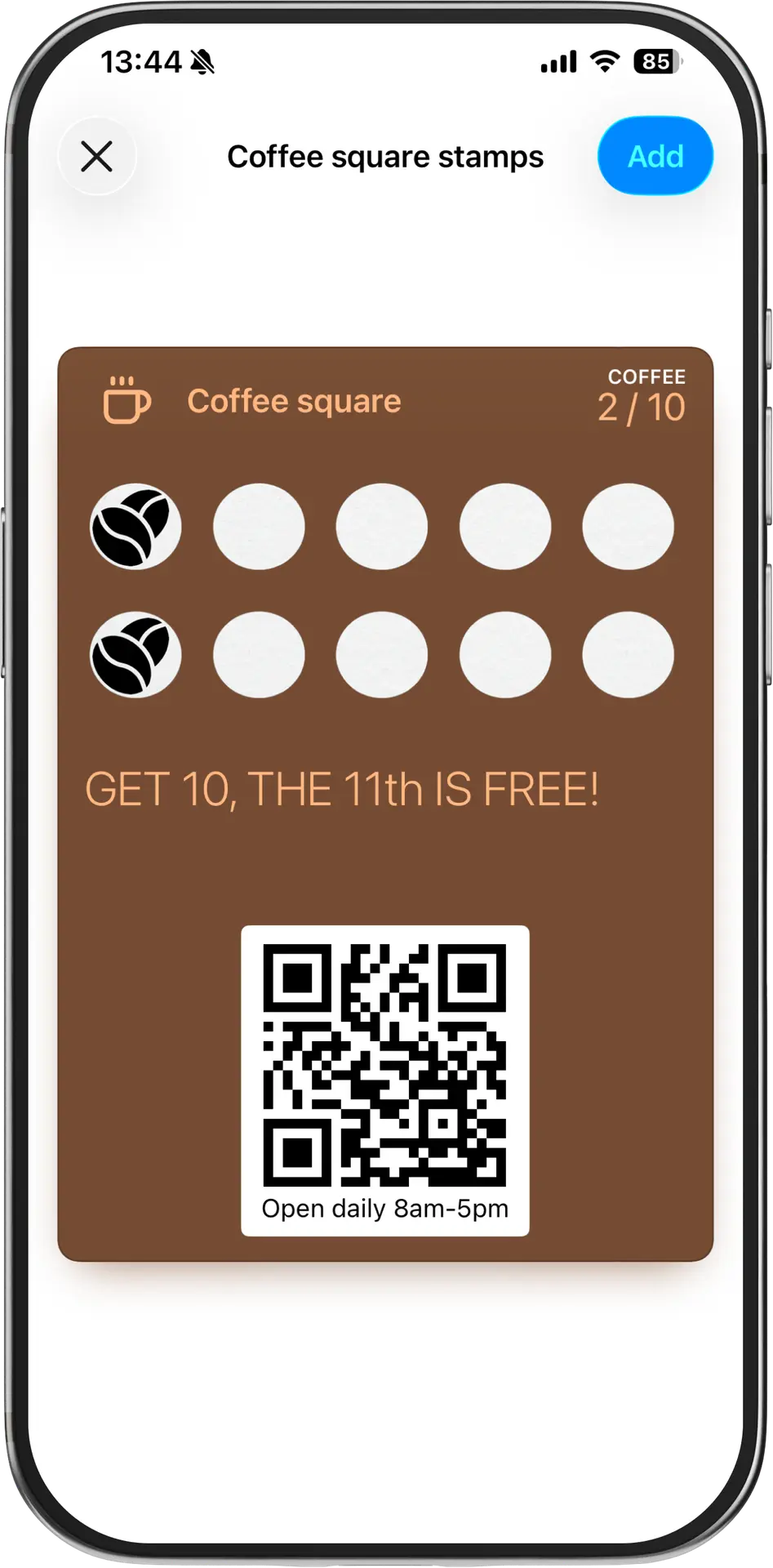
A customer walks into a café in Melbourne on a Tuesday morning and orders a flat white. While the barista is pulling the shot, they swipe up on their phone, the wallet card is right there, and they hold it out. The barista scans the QR code on the customer’s screen with their own phone — the same phone in their apron pocket. Stamp added. The whole interaction is under five seconds and runs in parallel with the espresso machine doing its work.
No POS integration. No second device behind the counter. No tablet at the till that needs charging. No scanner gun. The barista’s phone is the scanner — they open the staff side of the app once at the start of their shift and leave it ready.
When a customer hits ten stamps, the wallet card shows the reward is ready. They show the screen, the barista taps to redeem, and the next coffee is free. No tearing up the card, no manual reset.
For multi-barista shifts: every person on the team can stamp from their own phone, all updates sync in real time, and there’s a single dashboard that shows who stamped what — useful if you ever need to audit a discrepancy. For multi-location chains: each café has its own card, or you can run a shared card across locations. Both work.
Four objections café owners have.
“My regulars don’t want another app.”
They don’t need one. There’s no Loyably app for the customer. The card lives in Apple Wallet or Google Wallet — apps already on their phone. Tap the link, tap “Add to Wallet,” done. There’s nothing to open ever again — the card is in the swipe-up. The reason most digital loyalty programs fail at the café level is that they demand an app download. This one doesn’t.
“I don’t have time to set up tech stuff.”
Five minutes. Upload your logo, pick a card colour, set the stamp count, hit publish. There’s a demo at app.loyably.com/demo where you can click through the whole flow before signing up. No sales call, no onboarding session. You either find it intuitive in the first five minutes or you don’t — and if you don’t, nobody from the team is going to push you.
“I tried a loyalty thing before and it died.”
A few of them die for the same reasons. The customer had to download an app and didn’t. The hardware — tablet, scanner — broke or got unplugged. The staff stopped asking because the workflow added friction. Or, most often, there was no way to message customers when they stopped coming in, so the program just slowly went quiet.
The wallet-based approach removes the first two. The five-second redemption removes the third. The push notifications remove the fourth. None of this is a guarantee. It removes the specific failure modes that killed the last attempt.
“What if a customer’s phone is dead, or they left it at home?”
You can stamp them manually from the dashboard — search by name or email, add the stamp, done. The customer sees it the next time they open their wallet. Same goes for someone with an older phone, or somebody who doesn’t want a digital card: you can keep a small paper backup for those few. The digital and paper sides don’t fight each other.
Push notifications, written for café reality.
10% off pastries until close. See you this afternoon.
The notifications feature is the one operators get most wrong, because the platforms that sell it oversell it.
The rule: push notifications work when they tell a customer something they would have wanted to know anyway. They fail when they remind a customer that you exist.
A good push
- A new bean drop you’re proud of. Once. To people who’ve redeemed at least one reward.
- A slow Tuesday afternoon, 2 PM — “10% off pastries until close.” Local, time-bound, useful.
- A new menu launch. Once, with a photo.
- A customer hasn’t been in for three weeks. One nudge with a small offer. Then nothing.
Where to be careful
- Peak hours when your regulars are already coming in. A push at 8:15 AM on a weekday is the moment most likely to feel like interruption rather than value — your customer was already heading in. Save the push for moments when you actually need to pull people in.
- Anything generic. “Come grab a coffee!” reads as noise. Skip it.
- More than once a week as a rough ceiling. The card lives in their wallet alongside their plane tickets. Treat it with the same restraint.
The push works because the card is already in the wallet and the notification arrives like a calendar alert, not a marketing email. That credibility is yours to keep or burn.
Questions café owners actually ask.
Straight answers, no marketing fluff.