Digital stamp cards for fast food.
Digital stamp cards — or punch cards, depending on where you grew up — built for fast food and takeaway shops. Customers save the card to Apple Wallet or Google Wallet. No app to download. No POS to swap out. Live in five minutes.
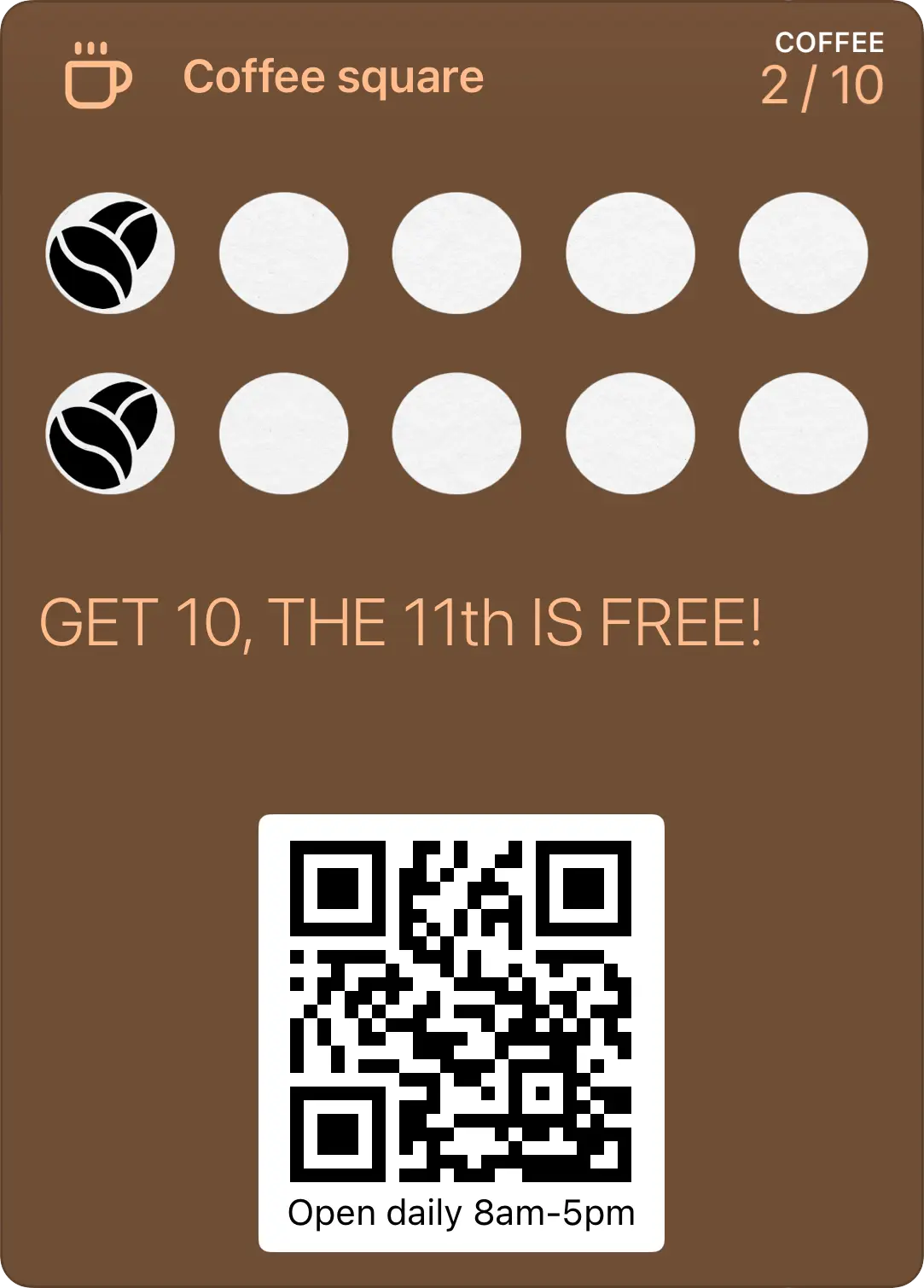


Fast food has the frequency and the ticket. The habit is the part you build.
Visits are frequent
The weekday lunch crowd is the same faces on a loop.
The ticket is small and steady
No wide spread — every order is roughly the same size.
The habit is the part you build
They picked you because you were close and fast, not because it’s “their” place.
A stamp card works when three things are true at once: visits are frequent, the ticket is small, and there’s a habit to reinforce. Fast food has the first two outright. The weekday lunch crowd comes four or five times a week, the order is €6–9 every time with almost no spread, and per-visit stamping is as clean as it gets — one order, one stamp, no math.
The third one is where fast food differs from a café, and it’s worth being straight about. A café regular is on autopilot — same flat white, same counter, part of who they are before the 9 AM stand-up. A lunch customer isn’t loyal to you that way. They walked in because you were close and the queue was short. Tomorrow a different place is closer, or the queue there is shorter, and they’re gone. The relationship a café leans on doesn’t exist here, and the staff turnover means nobody behind the counter knows the customer’s name anyway.
That’s not a reason a stamp card fails in fast food. It’s the reason it matters more. The card is the thing that manufactures the reason to come back when there’s no ritual and no rapport doing it for you. A regular who’s four stamps into a ten-stamp card has a reason to walk past the place next door — a reason that lives on their phone, not in whether a staff member remembers them. Fast food is the second-cleanest fit for a stamp card of any local business, right behind cafés. The frequency and the ticket are textbook. The card supplies the habit.
Fast food, takeaway, quick service — same shop, different word.
“Fast food” is the American and global term. “Takeaway” is what the same shop is called in the UK, Ireland, and Australia — food ordered at a counter and eaten elsewhere. The industry calls all of it “quick service” or “QSR,” but that’s a phrase owners rarely use about their own shop. Whatever you call it — burger joint, kebab shop, fried chicken counter, noodle bar, taco window — if customers order fast, pay a small consistent amount, and come often, everything on this page applies. We’ll use “fast food” and “takeaway” interchangeably throughout.
What earns a stamp when there’s a combo on the menu.
One order, one stamp, regardless of size. Clean, fast, nothing to calculate at the till. Fits the small consistent ticket that fast food already has — a €7 lunch and a €9 lunch both earn one stamp, and nobody at the counter does arithmetic during a rush. This is the right call for most shops.
One stamp per threshold — say one stamp per €10. Use this only if your orders genuinely range wide: family-sized orders, group lunches for an office, a shop where one customer buys for six people. If most of your orders are one person buying one meal, per-spend adds friction for no gain. Stick with per-visit.
The combo question trips people up more than it should. A customer orders a burger-fries-drink combo — is that one stamp or three? Per-visit answers it instantly: it’s one order, so it’s one stamp. The combo is one purchase. You don’t stamp the components.
The only reason to reach for per-spend is a real spread in order size. A takeaway where half the orders are a single wrap and half are a €40 family bucket has a fairness problem with per-visit — the family order and the single wrap earn the same stamp. Per-spend fixes that. But it’s the exception. Most fast food is one person, one meal, roughly the same price every time, and per-visit is both simpler for your staff and faster at the counter — which matters more here than anywhere.
Stamp count: Fast food fills cards faster than a café, because the visits are denser. Eight to ten stamps is the usual range — a four-or-five-times-a-week lunch regular finishes a ten-stamp card in about two weeks, which keeps the reward feeling close without giving the shop away. Higher-margin shops can sit at the top of that range; tighter-margin ones can drop the reward value rather than stretch the count. You can change the number from the dashboard later without resetting anyone’s progress. (More on stamp card mechanics in the main guide.)
Free item or money off — the choice is about your margin.
“Buy nine, get the tenth free.”
The reward is a specific menu item — ideally a high-margin one. Customers read a free burger as worth its full menu price, but it costs you only what it costs you to make, so the giveaway is cheaper than it looks. The completion — a full card, a thing handed over — lands harder than a number ticking down. Best when you have an item with a comfortable margin to give away.
“Spend enough, get 10% off” or a fixed voucher (€5 off your next order).
The reward is a discount rather than a product. It feels less like a gift, and it costs you real cash on every redemption rather than just food cost — but it caps your exposure and works when no single item has the margin to give away free. Best for thin-margin shops or ones where the order size varies a lot.
The reward question splits fast food owners, and the honest answer is that it depends on one number: your margin on the thing you’d give away.
A free item is usually the more efficient reward, because the gap between what the customer thinks it’s worth and what it costs you is widest. A burger that sells for €8 might cost you €2.50 to make — the customer values the reward at €8, you spend €2.50, and the nine paid orders before it were all full price. That’s a far better deal than a flat percentage discount, which hands the same money back to every customer on every redeemed order, including the ones who’d have come anyway. A free item also dodges the mental-math problem: “get a free meal” is instantly legible in a way “12% off” isn’t.
Money off earns its place in two situations. The first is thin margins — if you’re running on the kind of margins where giving away a whole meal genuinely hurts, a capped voucher (€3 off, or 10% off) limits the damage in a way a free item can’t. The second is a wide spread in order size, the same condition that pushes you toward per-spend stamping: when one customer’s order is a €4 wrap and another’s is a €40 family bucket, a percentage reward scales fairly where a free item over- or under-rewards depending on who’s holding the card.
A practical guardrail either way: keep the effective discount in the 5–10% range. Below 5% and the reward isn’t worth chasing; above 10% and you’re eating margin you didn’t need to give up. The free-item route usually lands inside that band on its own (the buy-nine-get-one model is roughly a 10% delayed discount, but only to your most loyal customers). The voucher route you set explicitly — which is the point of choosing it.
Loyably runs both reward types on a stamp card, and you can also run a separate coupon card alongside it if you want one-off offers that aren’t tied to stamps. (Coupon cards.) You can change the reward from the dashboard without resetting anyone’s progress, so this isn’t a decision you’re locked into — pick the one that fits your margin today and adjust if it isn’t working.
What changes when the card goes digital.
- Shoved in a pocket at the till, never seen again
- Lost between lunch today and lunch tomorrow
- The stamp tool walks off behind the counter
- A different person on the till every few weeks, none of them sure of the rules
- You served 200 today — no idea how many were repeats
- Lives in Apple / Google Wallet, next to the boarding passes
- Never lost, because it’s their phone
- Nothing to download, nothing to hand out
- Any staff member can stamp from their own phone
- Repeat rate and visit frequency in your dashboard
Paper punch cards leak hardest in fast food. The interaction is three minutes long, the customer is mid-lunch-break, and the card goes straight into a pocket with the receipt and is gone by tomorrow. Multiply that by a counter that does a couple hundred orders a day and the program is mostly invisible — to the customer and to you.
Digital fixes the leaks without changing the mechanic. The card lives in the customer’s Apple Wallet or Google Wallet, the same place as their boarding passes — they don’t lose it because it’s their phone, and there’s nothing to download. On your side, you stop guessing. You can see how many of today’s orders were repeat customers, which days run cold, and which regulars have gone quiet — and you can message them. Paper gives you none of that. (See how Apple Wallet cards work and Google Wallet.)
Does it slow the line? No — the scan runs in parallel.
- Step 01
Order placed
Customer orders, you ring it into the POS you already use.
- Step 02
Swipe up
Wallet card is already on their phone. They hold it out while they pay.
- Step 03
Staff scans
Phone-to-phone, from a pocket. Stamp added in under five seconds.
- Step 04
Reward ready
At ten stamps, the wallet shows the free item. Tap to redeem.
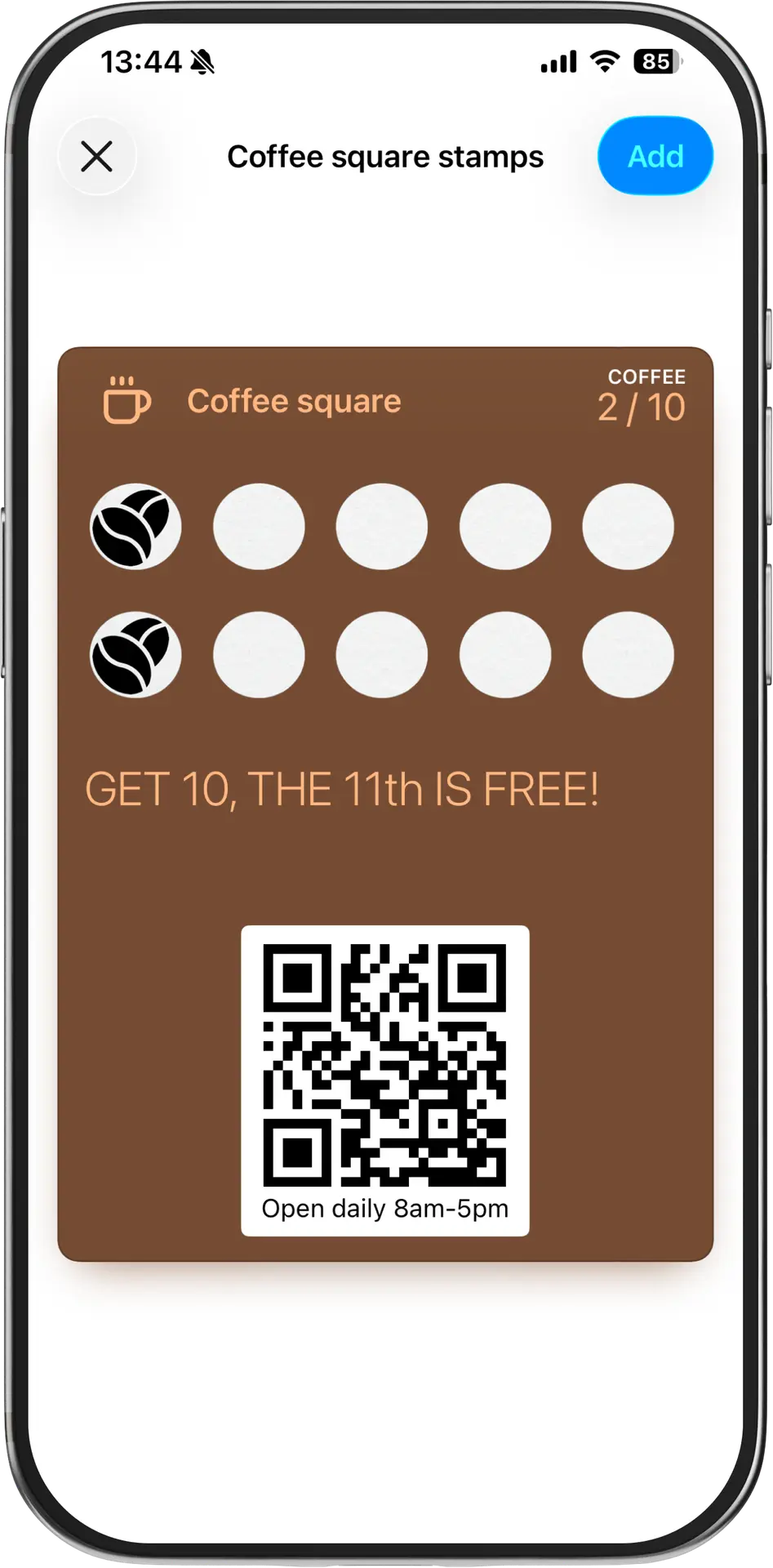
Speed is the whole game in fast food, so this is the objection that matters most: does a loyalty card slow the queue? It doesn’t, because the scan happens in the dead time you already have — while the customer is paying and the order is being made. The card is already in their wallet; they swipe up and hold the phone out, a staff member scans it from their own phone, and it’s done in the time it takes the card reader to clear.
Nothing about your existing setup changes. The POS or till stays exactly as it is — Loyably sits alongside it, it doesn’t replace it. There’s no second device to buy, no tablet at the counter, no scanner gun. If you run a drive-thru, the customer can add the card from the QR on the bag or receipt after the fact, and stamp on their next visit. If you have self-order kiosks, the QR goes on the kiosk screen and the receipt. The card never sits in the critical path of taking an order.
For shifts with several people on the till, everyone stamps from their own phone and it all syncs in real time. Running more than one location? Each shop can have its own card, or you can run a single shared card across all of them so a stamp earned at one branch counts at the next — both work, managed from one dashboard.
Four things fast food owners say.
“My customers are in and out. They won’t bother with a card.”
The ones who come once won’t, and that’s fine — they were never your loyalty customer. The card is for the lunch regular who’s already coming four times a week without anything to show for it. They’re the easiest sell you have: they’re standing at your counter on a Tuesday for the fourth time, and you’re offering them a free meal for behaviour they’re already doing. The signup is one tap to add it to a wallet they open all day anyway. You’re not asking them to change anything — you’re paying them for the habit they already have.
“This’ll slow down my queue.”
It runs in parallel with paying, the same way tapping a card does — under five seconds, in the dead time you already have, on the staff member’s own phone. No extra device, no till swap. The shops where loyalty slows the line are the ones running a separate tablet and a separate app. This isn’t that. (Full breakdown in the counter section above.)
“My regulars order on Deliveroo / Uber Eats now anyway.”
Then the platform owns that customer, not you — and it’s taking a cut of every order on top. A wallet card is one of the few levers you have to pull a customer back to ordering direct: stamp in-person and direct-pickup orders, not third-party delivery ones, and the card quietly rewards the channel that doesn’t cost you a commission. It won’t move everyone off the apps. It gives your most frequent customers a reason to come to you directly, which is exactly the customer you most want off the platform.
“I tried a loyalty thing before and it died.”
Most of them die the same few ways: the customer had to download an app and didn’t, the hardware broke or got unplugged, the staff stopped asking because it added a step, or there was no way to reach customers once they drifted. The wallet approach removes the first two — no app, no hardware. The five-second counter scan removes the third. Push notifications cover the fourth. No guarantees — it removes the specific things that killed the last attempt.
The dead-afternoon push is the one that pays for itself.
Double stamps on every order, 2–5 PM today.
Fast food has a shape to its day: a lunch spike, then a long dead stretch, then maybe an evening one. The push notification earns its keep in the dead stretch. It’s 2 PM, the rush is gone, you’ve got staff standing around and prep already done — you send a flash offer to every cardholder’s lock screen (“double stamps until 5”) and you pull a slice of the lunch crowd back for a second visit they weren’t going to make. That afternoon pays for itself.
A good push
- The dead 2–5 PM stretch — double stamps or a small add-on offer, time-boxed to today.
- A new item you want frequent customers to try. Once, with a photo.
- A customer who hasn’t been in for two weeks — one nudge with a small offer, then nothing.
Where to be careful
- The lunch rush itself. A push at 12:15 on a weekday hits people who were already coming in — it reads as interruption, not value. Save it for when you actually need to pull people in.
- Anything generic. “Come grab lunch!” is noise. Skip it.
- More than once a week, roughly, as a ceiling. The card sits next to their boarding passes. Same restraint.
The push works because it arrives like a calendar alert, not a marketing email — it’s in the wallet, not an inbox. That credibility is yours to keep or burn.
Questions fast food owners actually ask.
Straight answers, no marketing fluff.