Digital stamp cards for lunch spots.
A lunch business runs on a rhythm nothing else in food shares: five days, one narrow window, the same faces, and a customer who is quietly choosing between you and four other places within a two-minute walk. A stamp card’s whole job here is to win that choice. Cards live in Apple Wallet and Google Wallet — nothing for your customers to download.
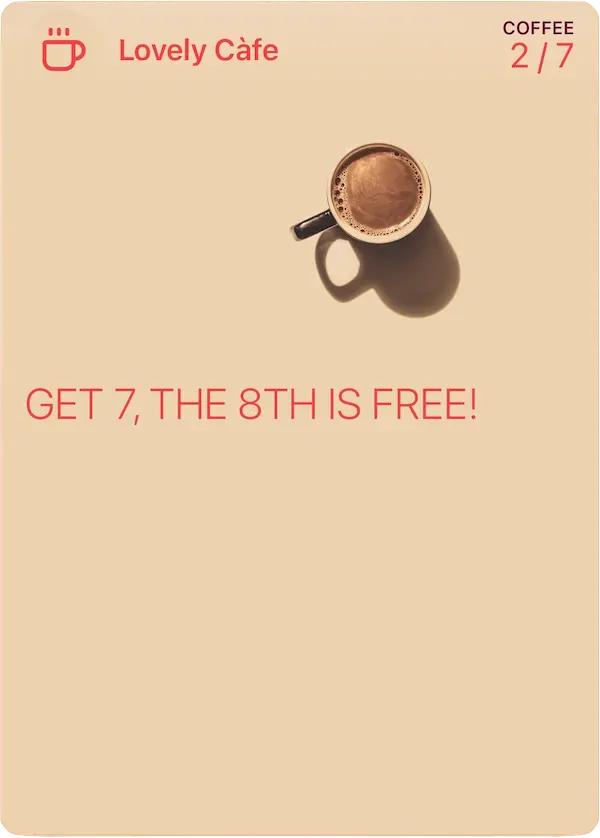


The lunch rush is built for a stamp card.
A stamp card works when the same person comes back often and spends in a narrow band each time. The weekday lunch trade clears both by its nature, whatever you sell.
An office worker who buys the same salad three times a week, the regular who alternates between your counter and the two others nearby, the team that does a standing Friday order. Small tickets, tight range, high frequency — the precise shape a stamp card was built for. It doesn’t matter whether you’re a deli, a salad bar, a hot-counter, a bowl shop, or a sandwich place. Lunch is the occasion, and the occasion is what makes the card fit.
The narrow ticket is the quiet advantage. A stamp rewards the visit, not the spend, which is a problem in a restaurant where one bill is triple the next. Lunch doesn’t have that problem — a midday order lands in roughly the same band every time — so the stamp is fair on every visit, and nobody feels short-changed for ordering light.
Your real competition is the four places next door.
Here’s the thing about lunch that no generic loyalty pitch will tell you: your customer isn’t deciding whether to eat. They’re deciding where, out of four or five options inside a short walk, and they rotate between them out of mild boredom and habit. You are not fighting to win lunch. You’re fighting to be the default in a rotation.
That changes what a stamp card is for here. It isn’t a thank-you for loyalty you already have — it’s a thumb on the scale in a daily coin-flip. A customer four stamps into your card and zero into the place next door has a reason to break the rotation in your favour today. The card converts “I’ll go wherever” into “I’ll go to the one I’m building toward.” For a lunch business, that nudge is the whole game, because the underlying choice is so close to a toss-up.
First, the finish line has to be reachable — a lunch regular should see the reward coming within a few weeks, or the card is too weak to tip a daily decision. Second, the reward should be a lunch item, not a discount: a free sandwich or bowl pulls them back through your door specifically, while a percentage off just makes you marginally cheaper than the place next door, which is a race you don’t want to run.
Five days, not seven — set the card to match.
A regular comes maybe 3–4× a week
A lunch business has a ceiling most food businesses don’t: there are only five lunch days in a week, and for many lunch spots the weekend barely exists. That caps how fast any customer can fill a card, and it’s worth building around rather than ignoring.
A genuine lunch regular might come three or four times a week at most. So a card calibrated like a seven-day business — a high count that assumes daily visits — will feel slow and get abandoned. Set the count to the real weekday ceiling: a number a three-times-a-week regular can finish in a few weeks. And know that the rhythm has a natural break every weekend, which is fine — the card sits in their wallet, and the reminder that they’re partway to a reward is waiting on Monday.
This is also why a lunch card and a dinner restaurant’s card shouldn’t look the same. Same building, sometimes, but lunch is a faster, narrower, shorter-week business, and the card that fits it is tuned tighter.
Reward the lunch, keep the margin.
Lunch margins are thin and the volume is the business, so the reward needs to pull people back without eating the thin margin that makes lunch work.
Reward a lunch item, not a discount on the bill. A free sandwich, bowl, or salad after a reachable count reads as a real gift and brings the customer back through your door for the specific thing you make. A percentage off the whole order trains people to wait for the discount and quietly erodes the margin on every other order. Pick the item with the best margin-to-perceived-value ratio — usually your core lunch dish, where the food cost is a fraction of the price — so the free one costs you a little and feels like a lot. Keep the reward to the lunch you want to sell more of, not your most expensive add-ons.
The office order is loyalty worth keeping — but it isn’t a stamp.
Many lunch spots have a few standing team orders — the office that calls in lunch for ten every Friday. That’s real, valuable, repeat business, and it’s tempting to treat it as a stamp engine. Be careful with it.
A big team order is one transaction placed by one person, often on the company card. Stamping it as a single visit under-rewards a large order; counting each meal as a stamp hands a fast free lunch to a buyer who isn’t personally choosing you out of the rotation — the office is. The cleaner approach is to keep standing team orders on their own footing (a direct relationship, a standing arrangement) and let the stamp card do its real job: winning the individual who walks in and picks you over the four places nearby. Reward the personal habit you’re trying to build; handle the team order as the separate, welcome thing it is.
Standing team orders: a direct, separate arrangement. The stamp card: built to win the individual walk-in. Don’t mix the two and they both work harder.
The paper card never survives the rush.
The cardboard punch card and the lunch rush are a bad match, and the rush is the whole business.
Nobody’s digging for it at half past twelve. Staff punch the wrong box trying to keep the queue moving. The card lives in a coat pocket on a day the customer left the coat at the office. And it tells you nothing — paper can’t say who your regulars are or who’s slipped out of the rotation.
On the same phone they’re paying with. Can’t be lost or double-punched in the rush. Quietly tells you who comes in and when each regular last did — so when one of your three-times-a-week faces goes quiet, you know before they’ve drifted next door for good.
At half past twelve with a line out the door, nobody’s digging for a paper card, and staff punch the wrong box trying to keep the queue moving. The card lives in a coat pocket on a day the customer left the coat at the office. And it tells you nothing — paper can’t say who your regulars are or who’s slipped out of the rotation.
A card in Apple Wallet or Google Wallet is on the same phone they’re paying with. It can’t be lost or double-punched in the rush, and it quietly tells you who comes in and when each regular last did — so when one of your three-times-a-week faces goes quiet, you know before they’ve drifted to the place next door for good.
One tap at the till. The card does the rest.
- Step 01
Add the card
Customer scans a QR once — on the counter, by the till, or on the menu — and it’s in their wallet.
- Step 02
Order as usual
They order the same lunch they always do. Nothing about the queue changes.
- Step 03
Staff taps
A stamp is one tap on a device your staff already hold. No second device, no POS work, no login to fumble mid-rush.
- Step 04
Reward ready
At the count, the wallet shows the free lunch. Tap to redeem.
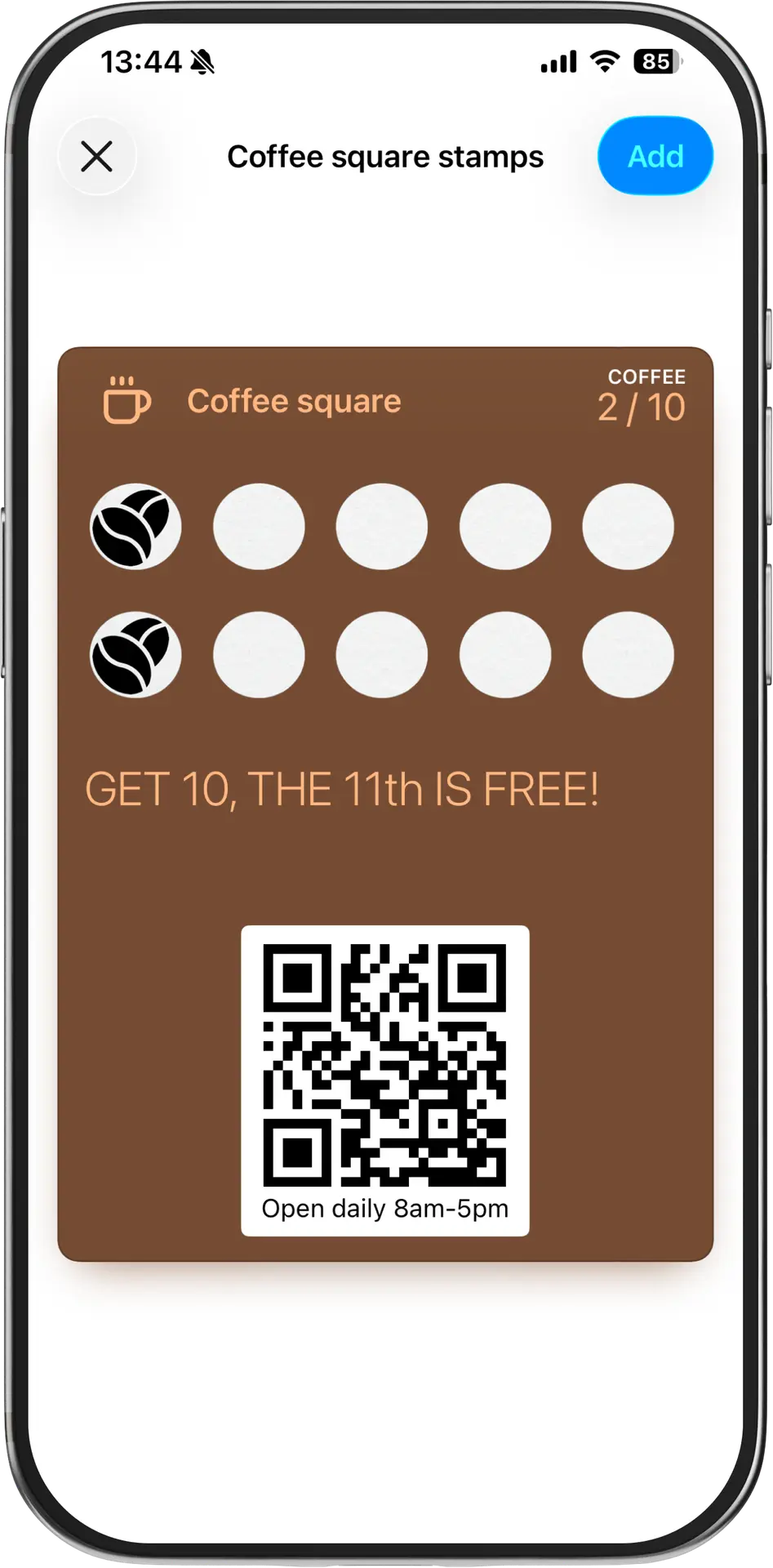
The lunch rush is the whole business, and the card stays out of its way. The scan runs in the dead time you already have — while the customer is paying — so it never sits in the critical path of the queue. Nothing about your existing till changes: the card runs alongside it, not through it. A new hire can run it on their first shift without a sit-down training session, because there’s only one thing to do — tap once when someone pays.
Questions from the lunch counter.
Straight answers, no marketing fluff.