Loyalty cards for massage therapists — and an honest look at which one fits.
A digital card that lives in your client’s Apple or Google Wallet with one tap — stamp card, gift card, or membership, no app to download. We’ll also tell you plainly where a stamp card fits a massage practice and where it doesn’t, because for a lot of therapists the gift card and the membership do the real work.


The gap between how often clients should come and how often they do.
Most loyalty advice assumes a tidy rhythm — same client, same visit, same gap. Massage has a gap of its own, but it’s a different kind: the space between the frequency that helps and the frequency clients book.
Therapists know this. The research on massage for chronic pain or stress mostly uses weekly or fortnightly sessions — that’s where the results show up. But most clients don’t book like that. They come once a month if you’re lucky, or when their shoulders seize up, or before a marathon, or because someone gifted them a session — and then not again for half a year. You’re not imagining the drift; it’s built into how people treat massage. They mean to come back. Life fills the gap.
A stamp card rewards regular, equal visits. Massage often delivers neither — irregular timing, and a ticket that swings from a 30-minute neck-and-shoulders to a 90-minute deep tissue. So before we sell you a stamp card, here’s the honest split, because for a real share of massage practices the better tool isn’t a stamp card at all.
Where a stamp card does fit.
A stamp card works for massage in one specific case: you have routine clients on a standing rhythm.
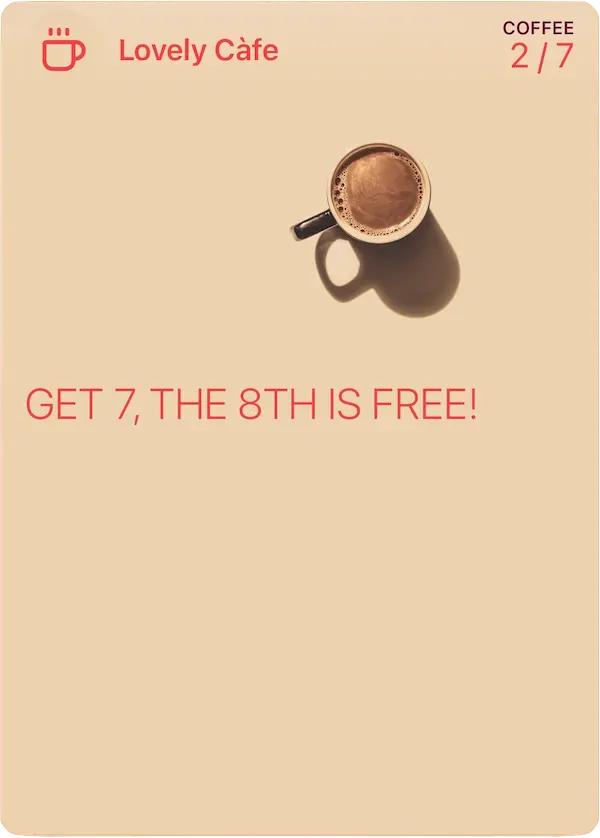
If a meaningful slice of your book is regulars — the fortnightly chronic-pain client, the monthly maintenance client, the standing-appointment crowd — a stamp card rewards exactly the behaviour you want more of, and the wallet card keeps it on their phone instead of in a drawer. For them, “buy six sessions, get the seventh” is clean and fair.
Or fewer. About three months to the reward for a fortnightly client.
If that’s most of your book, run a stamp card. Six is the number — six sessions for a fortnightly client is about three months to the reward, close enough to feel real. For a monthly client it’s longer, so keep the count at six or below; don’t stretch it. But if routine regulars are only a corner of your book, the next two sections matter more.
The gift card is the acquisition tool you’re not using.
For most massage practices, the strongest thing in the wallet isn’t a stamp card — it’s a digital gift card. And it’s doing a different job: not retention, but acquisition.
One of the most-gifted services
Birthdays, anniversaries, “you’ve been working too hard, go relax.”
A new client on someone else’s money
The recipient is someone who might never have booked you otherwise.
Revenue locked in up front
You’re paid before anyone’s on the table.
Massage is one of the most-gifted services there is. Birthdays, anniversaries, “you’ve been working too hard, go relax.” That makes the gift card a way to bring a new client through the door on someone else’s money — the buyer pays up front, the recipient is someone who might never have booked you otherwise, and you’ve locked in the revenue before anyone’s on the table. A digital gift card lives in Apple or Google Wallet exactly like a stamp card — one tap, no app — and the recipient gets a reminder it’s sitting there unredeemed, which is what turns a thoughtful gift into a booked session.
If you do one thing from this page, it might be this: turn on gift cards before the next gifting season — Mother’s Day, the December holidays, Valentine’s — rather than the week of. The honest recommendation for many therapists is to lead with gift cards and add a stamp card only if the routine regulars justify it.
For the regulars, a membership beats a stamp card.
The other tool worth more than a stamp card for massage is the membership or prepaid package — and it targets the opposite end of your book from gift cards.
Predictable revenue for you
A membership (“one session a month for a set fee”) or a prepaid block (“buy five, save a little”) replaces irregular bookings with a rhythm you can plan against.
A reason for the client to keep the rhythm
For the clinically-minded therapist who wishes clients came fortnightly, a membership is the structure that nudges them toward it.
A membership (“one session a month for a set fee”) or a prepaid block (“buy five, save a little”) does two things a stamp card can’t: it gives you predictable revenue instead of waiting on irregular bookings, and it gives the committed client a reason to keep the rhythm that helps them. It’s how the bigger wellness chains turned massage into recurring income — and there’s nothing stopping a single-room practice from running the same play, simply, on a wallet card. For the clinically-minded therapist who wishes clients came fortnightly, a membership is the structure that nudges them toward it.
So the full honest picture: gift cards bring new clients in, memberships hold your committed regulars on a rhythm, and a stamp card sits in the middle for the standing-appointment crowd. Most practices need one or two of these, not all three — and rarely is a stamp card the first one to reach for.
How it works, and the reminder that matters most.
Whichever card fits you, the mechanics are the same, and your client downloads nothing.
You build the card
Logo, colours, the reward or gift value in one line. About five minutes.
The client adds it with one tap
Scans a QR code or taps a link; it lands in Apple or Google Wallet. No app, no account.
You stamp or redeem from your phone
Add a stamp, or scan a gift card to redeem.
Your shoulders earned this. You’re two stamps from a free session.
For a service as irregular as massage, the reminder is doing more work than the card. A client who came once after a stressful month won’t think of you again until the next bad month — unless something prompts them. A wallet notification a few weeks out — “your shoulders earned this, you’re two stamps from a free session” or “your gift card’s still waiting” — lands on the lock screen and reaches them when nothing else would. For gift recipients especially, that nudge is what converts an unredeemed gift into a booking, and a booking into a regular.
The card doesn’t replace your booking system. It does the one thing booking software can’t: reach a client who isn’t on a schedule. Your card data — who’s enrolled, who holds an unredeemed gift card, who’s due — is yours, hosted in the EU under GDPR.
Questions from the practice.
Straight answers, no marketing fluff.