Digital stamp cards for pizza.
Pizza is one of the cleanest fits there is for a stamp card. People come back inside the week, the order barely changes, and a free pie is one of the cheapest rewards a food business can give. This page is for the owner who’s already decided stamps make sense and wants to set one up that pays off. Cards live in Apple Wallet and Google Wallet — nothing for your customers to download.


Why pizza barely needs convincing.
A stamp card works when two things are true: the same person comes back often, and what they spend each time lands in the same narrow band. Pizza clears both without trying.
Take a corner slice shop on a weekday — the lunchtime regulars who grab two slices and a drink, four days out of five. Or a neighbourhood pizzeria where the same families order a Friday pie like clockwork. Different rooms, same shape: high frequency, a ticket that barely moves. That’s the exact pattern a stamp card was built for, the same one that makes coffee such an easy fit.
The order being predictable is the quiet advantage. A stamp rewards the visit, not the spend — which is a problem in a restaurant where one table runs 15 and the next runs 90. Pizza doesn’t have that problem. A slice-and-a-drink is a slice-and-a-drink. A large pepperoni is a large pepperoni. The check doesn’t swing, so the stamp is fair every time, and nobody feels short-changed for ordering light.
So we’ll skip the part where we talk you into it. If you sell pizza to people who come back, a stamp card fits. The rest of this page is about setting one up that pays off — the reward math, the one trap that quietly breaks pizza cards, and how a slice shop should run it differently from a whole-pie place.
A free pizza costs you far less than it looks.
Here’s the part most loyalty pitches get lazy about. They’ll tell you “buy 6, get 1 free” and move on, as if you’re giving away a whole pizza’s worth of value. You’re not.
When you hand over a free pie, you’re giving away its food cost — flour, sauce, cheese, a few toppings — not its menu price. For pizza, that gap is wide. The ingredients in a pizza are a small slice of what you charge for it; the rest is the oven, the rent, the labour you’re paying whether that customer redeems a reward or not. So the reward that looks generous on the card is one of the cheapest you can give in food. A café giving away a coffee is in similar territory. A restaurant giving away a steak is not.
That changes how you should set the card up. Because the reward is cheap relative to its perceived value, you can afford to make the finish line reachable — short enough that a regular sees it coming and speeds up to get there, rather than so long the card feels like a chore they abandon at stamp three. The free pie pulls its weight by changing behaviour, not by being rationed.
Two rules that follow from this:
A free pie reads as a gift and keeps every other order at full price. A percentage off the whole order trains people to wait for the discount and quietly erodes your margin on everything. Give the thing with the best margin-to-perceived-value ratio — and for a pizzeria, that’s the pizza itself.
The instinct is to push the count high so you “give away less.” It backfires. A card that takes too long to fill is a card nobody fills, and an unfilled card changes no behaviour at all. Set the count to the rhythm your regulars already keep, and let the cheap reward do its job.
A slice counter and a whole-pie place shouldn’t run the same card.
“Pizza” hides two different businesses, and the card should reflect which one you are.
Runs on frequency. Someone might come three times a week — a lunch slice, a late-night slice, a Saturday-afternoon slice. The ticket is small and the visits stack up fast. A stamp per visit with a reachable count keeps pace; set the bar where a genuine regular hits the reward in a few weeks, not a few months.
Runs on the weekly order. Same family, same Friday, one pie — maybe two. Fewer visits, bigger tickets, a longer gap between each. Keep the count lower than a slice shop’s; one stamp per order, a count they can finish inside a couple of months, a free pie at the end.
Same product, two clocks. The mistake is copying a number off someone else’s card without asking how often your particular customer walks in. Match the count to your real visit pattern and the card works in either room. Ignore the difference and the slice regular fills a card in a week while the weekly-pie family gives up before they’re halfway.
The one thing that quietly breaks a pizza card.
Every so often someone orders ten pizzas for an office party or a kid’s birthday. It’s a great order. It is not a stamp.
The temptation is to treat a big catering order as a single stamp, because that’s what your system does by default — one transaction, one stamp. But the whole point of a stamp card is to reward and build a habit: the walk-in, the weekly pie, the lunchtime slice. A party order is a one-off. The person placing it isn’t becoming a regular because they threw a party; they’ll be back when they throw the next one, a quarter from now. Counting it as a stamp toward a free pizza rewards an event you can’t repeat on demand and tells you nothing about who your regulars are.
Stamp the habit, not the party. The walk-in who comes every week is the customer the card is for. The catering order is welcome revenue — just keep it off the card, or you’ll end up handing free pizzas to people who were never going to become regulars, and learning nothing about the ones who are.
Delivery-app orders sit outside the card.
The card rewards orders that come to you directly — the walk-in, the phone order to your number, the order placed on your own site. Orders through third-party delivery apps sit outside it.
The reason is simple. When an order comes through a delivery app, the app already took its commission and the app owns the customer relationship — their saved card, their one-tap reorder, their default for next Friday. A stamp on that order doesn’t change where they order next; the app is still the easy option. The card is built to do the one thing the apps can’t do for you: take the customer who orders direct and give them a reason to keep doing it.
The delivery box is still useful — as a place to advertise the card. A sticker that says “order direct next time and start earning” turns an app order into a direct one down the line, which is the point. Use the box to win the next direct order rather than to stamp the last app one.
Walk-in, your phone line, your own site. The direct customer the card was built to reward.
Third-party delivery-app orders. The app already keeps the customer relationship.
The paper punch card, on a busy Friday.
The cardboard punch card works until the rush hits, and the rush is the whole business.
Lives in a coat pocket, a car door, the bottom of a bag — never on the customer at the counter when the line’s six deep. Staff punch the wrong box mid-rush. Card number four went through the wash. And paper tells you a reward got claimed, never who claimed it or when they last ordered.
Sits on the same phone they’re already holding to pay. Can’t get lost or double-stamped by a distracted hand on a Friday night. Tells you — quietly, in the background — who your regulars are and when each of them last came in.
Paper cards live in a coat pocket, a car door, the bottom of a bag — never on the customer at the counter when the line’s six deep. Staff punch the wrong box mid-rush. A regular who’s been ordering for months has nothing to show because card number four went through the wash. And you learn nothing: paper tells you a reward got claimed, never who claimed it or when they last ordered.
A card in Apple Wallet or Google Wallet sits on the same phone they’re already holding to pay. It can’t get lost, it can’t be double-stamped by a distracted hand on a Friday night, and it tells you — quietly, in the background — who your regulars are and when each of them last came in. If you’ve run a paper card, this is the same gesture with none of the paper.
One tap at the till. The card does the rest.
- Step 01
Add the card
Customer scans a QR once — on the counter, the menu, or a sticker by the door — and it’s in their wallet.
- Step 02
Order as usual
A slice and a drink or a whole pie to take home — nothing about how they order changes.
- Step 03
Staff taps
A stamp is one tap on a device your staff already hold. Phone-to-phone, a few seconds, no hardware.
- Step 04
Reward ready
At the count, the wallet shows the free pie. Tap to redeem.
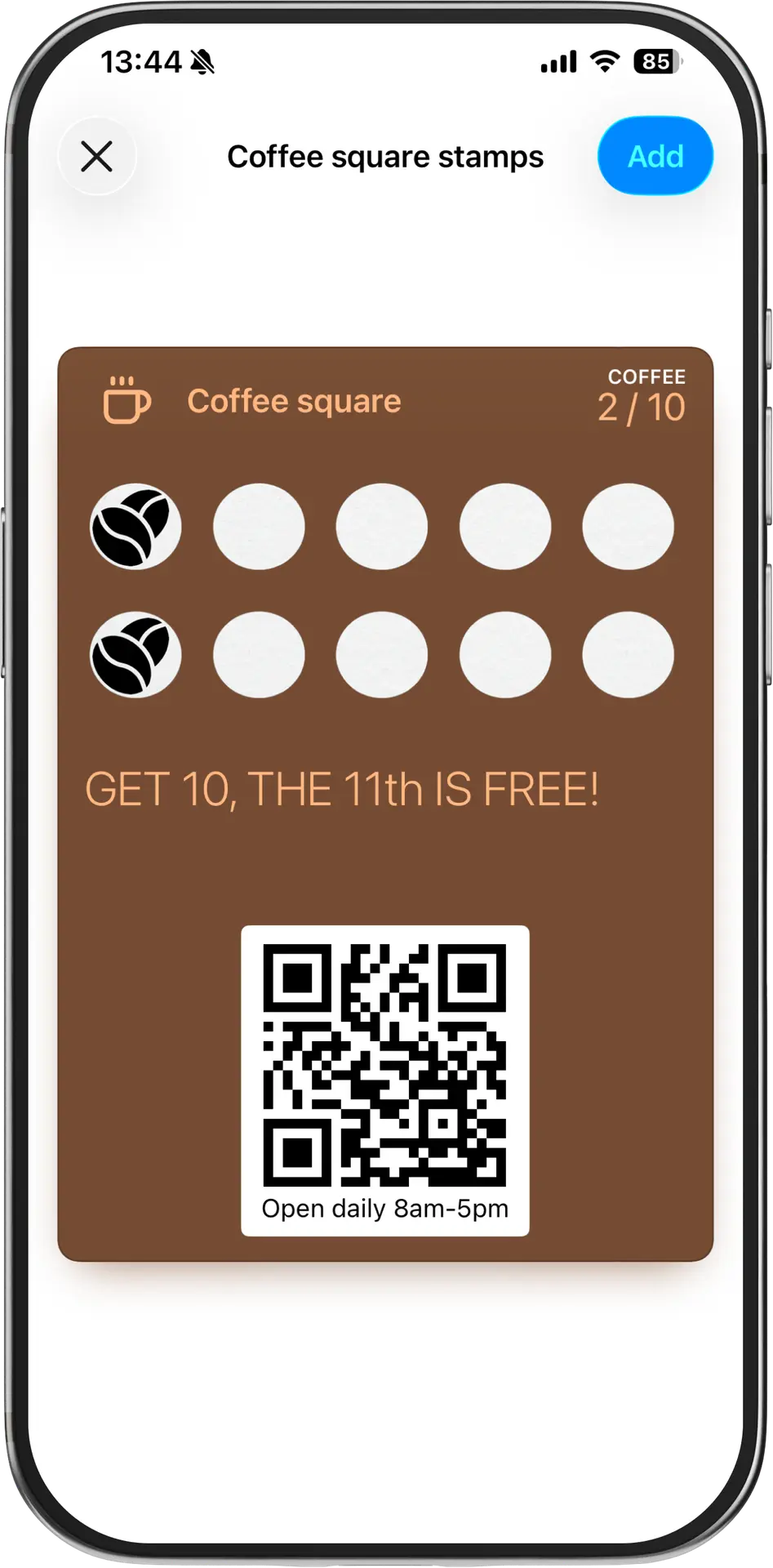
A pizza counter on a Friday night moves fast, and the card stays out of the way. The scan happens while the customer is already paying, so it never sits in the critical path of the line. Nothing about your existing till or POS changes: the card runs alongside it, the stamp happens on a phone, separate from the order. A new hire can run it on their first shift, because there’s only one thing to do — tap once when the customer pays.
Questions from the pizza counter.
Straight answers, no marketing fluff.