Loyalty cards for sushi restaurants.
Sushi is the one place where we’ll tell you a plain stamp card isn’t the whole answer. A lunchtime bowl and an evening omakase are not the same purchase, and a single stamp can’t fairly reward both. So this page is about the structure that fits sushi: points as the base, a stamp card layered on for the lunch crowd. Both live in Apple Wallet and Google Wallet — nothing for your customers to download.


The real problem with stamping sushi.
Most loyalty tools will happily sell you a stamp card for any food business and move on. For sushi, that’s the wrong default, and it’s worth saying why before you set one up.
A stamp card rewards the visit, not the spend. That’s perfect when every visit costs roughly the same — a coffee, a slice, a single pizza. Sushi doesn’t behave that way. Picture the room: a weekday regular grabs a bento at the counter for the price of a sandwich, while two tables over an evening couple works through an omakase and a bottle of sake for ten times as much. One stamp for each treats those two as equal. The bento regular fills a card fast for very little spend; the omakase couple feels their premium evening barely counted. The card is unfair in both directions.
So the question for sushi isn’t “stamp card or not.” It’s “what rewards the wide spread of how people spend here.” For most sushi restaurants, that’s a points base — and a stamp card added on top for the one part of the business that does behave like a stamp business: lunch.
Points reward the full range of what sushi sells.
A points card fixes the fairness problem by rewarding spend in proportion. One point per unit of currency spent, a reward unlocked at a threshold. The bento lunch earns a little, the omakase evening earns a lot, and nobody feels short-changed — the reward scales with what each customer brought.
This matters more for sushi than for almost any other food business, because sushi’s range is unusually wide. The same restaurant might serve a quick takeaway roll, a sit-down lunch set, a celebration omakase, a sake flight, and a tray of party platters for an office. Points are the only structure that treats all of those fairly with one card. Set a threshold that takes a genuine regular a handful of visits to reach, pick a reward that reads as a real thank-you — a free roll, a discount on the next omakase — and the card rewards loyalty across the whole menu rather than just the cheap end of it.
The bento lunch earns a little. The omakase evening earns a lot. The reward scales with the spend.
Points also carry the data a sushi restaurant should want: who your high-spend evening regulars are, who comes for lunch and never returns at night, who hasn’t been back in two months. That’s the input for a quiet nudge at the right moment, which matters more in a business with a long gap between premium visits.
Where a stamp card still earns its place: lunch.
There’s one slice of a sushi restaurant that behaves like a pizza shop, and it’s lunch.
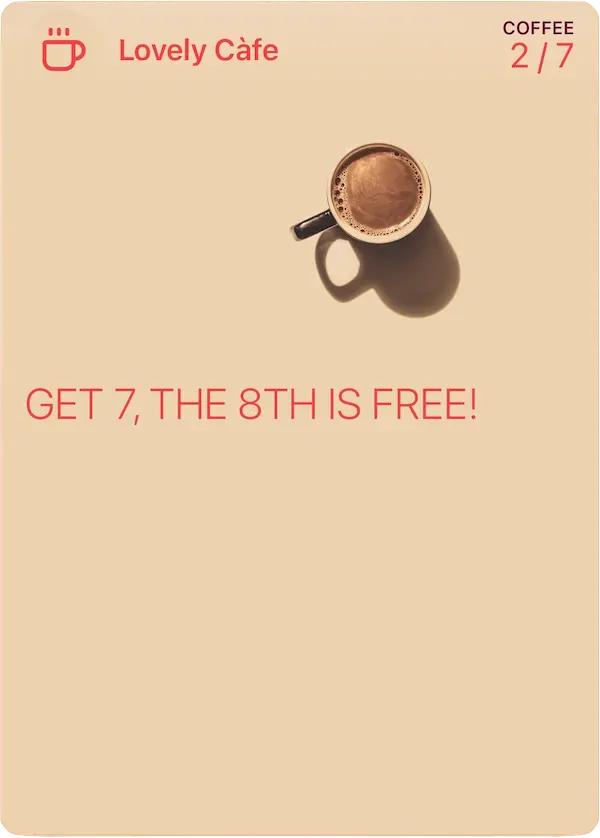
The weekday lunch crowd is a different animal from the evening diner. They come often — two, three times a week — they order in a narrow band (a bowl, a set, a few rolls), and the ticket barely moves. That’s the exact tight-ticket, high-frequency pattern a stamp card was built for. So the structure that fits is a stamp card aimed only at lunch: every eighth lunch bowl free, say, running alongside the points base that covers everything else.
Lower-frequency, premium tickets, wide range. Fits a points card that rewards spend across the whole menu.
High-frequency, tight band, two or three times a week. Fits a stamp card that rewards the visit.
This is the part most sushi loyalty advice misses. It treats the restaurant as one thing and picks one tool. The truth is a sushi restaurant is two businesses under one roof — a high-frequency lunch counter and a lower-frequency premium dinner room — and the loyalty that fits each is different. Points for the room as a whole; a stamp card for the lunch regulars who’d fill one fast and come back to do it again.
You don’t have to run both on day one. If lunch is your volume, start with the lunch stamp card and add points later. If your business is evening-weighted, start with points. The point is to match the tool to the behaviour rather than forcing one card to do a job it’s wrong for.
What to give away when the product is premium.
Sushi has a margin shape worth thinking about before you set a reward. Some items — rice-heavy rolls, lunch sets — carry the kind of margin where a free one costs you little. Others — premium nigiri, sashimi by the piece, anything built on expensive fish — are a different story. Give away the wrong free item and the reward stings.
So reward the high-margin end. A free lunch roll, a free side, a discount applied to the next visit rather than a free piece of premium nigiri — these read as generous to the customer while costing you close to food cost on an item where food cost is low. Keep the expensive fish off the free-reward list, or cap the reward’s value, so a loyalty win never lands on your worst-margin plate. The customer feels rewarded; you stay in control of which dish you’re giving.
Direct orders earn; delivery-app orders sit outside.
Plenty of sushi moves as takeaway, and the line to draw is the same one any food business should. Orders that come to you directly — walk-in, your phone line, your own site — earn on the card. Orders through third-party delivery apps sit outside it.
When an order comes through a delivery app, the app already took its commission and keeps the customer relationship — their saved card, their reorder button, their default for next week. A point or stamp on that order doesn’t change where they order next; the app is still the easy option. The card is built to reward the direct customer and give them a reason to keep ordering direct. The takeaway bag is still a fine place to advertise the card — a sticker that turns an app order into a direct one next time is the point.
Walk-in, your phone line, your own site. The direct customer the card was built to reward.
Third-party delivery-app orders. The app already keeps the customer relationship.
The paper card and the long gap between visits.
Lost in a coat pocket or a washing machine. Sitting unmoved in a wallet for weeks between premium visits, telling you nothing and reminding the customer of nothing.
Sits next to a boarding pass in Apple or Google Wallet. Knows when each customer last came in, so a quiet nudge can reach a drifting regular before they pick somewhere else.
Paper punch cards fail sushi twice over. They get lost like any paper card — coat pocket, car door, washing machine. But sushi has a particular problem: the gap between premium visits can run weeks, and a paper card that’s been sitting in a wallet since last month tells you nothing and reminds the customer of nothing.
A card in Apple Wallet or Google Wallet can’t be lost, and it does the thing paper never could — it knows when someone last came in, so a quiet nudge can reach the evening regular who hasn’t been back in six weeks before they drift to the place down the street. For a business with long gaps between high-value visits, that reminder is worth more than the stamp itself.
One tap at the till. The card does the rest.
- Step 01
Add the card
Customer scans a QR once — on the counter, the table, or the chopstick sleeve — and it’s in their wallet.
- Step 02
Order as usual
Lunch bowl or evening omakase, takeaway or dine-in — nothing about how they order changes.
- Step 03
Staff taps
A point or a stamp is one tap on a device your staff already hold. Phone-to-phone, a few seconds, no hardware.
- Step 04
Reward ready
At the threshold, the wallet shows the reward — a free roll, a discount on the next visit. Tap to redeem.
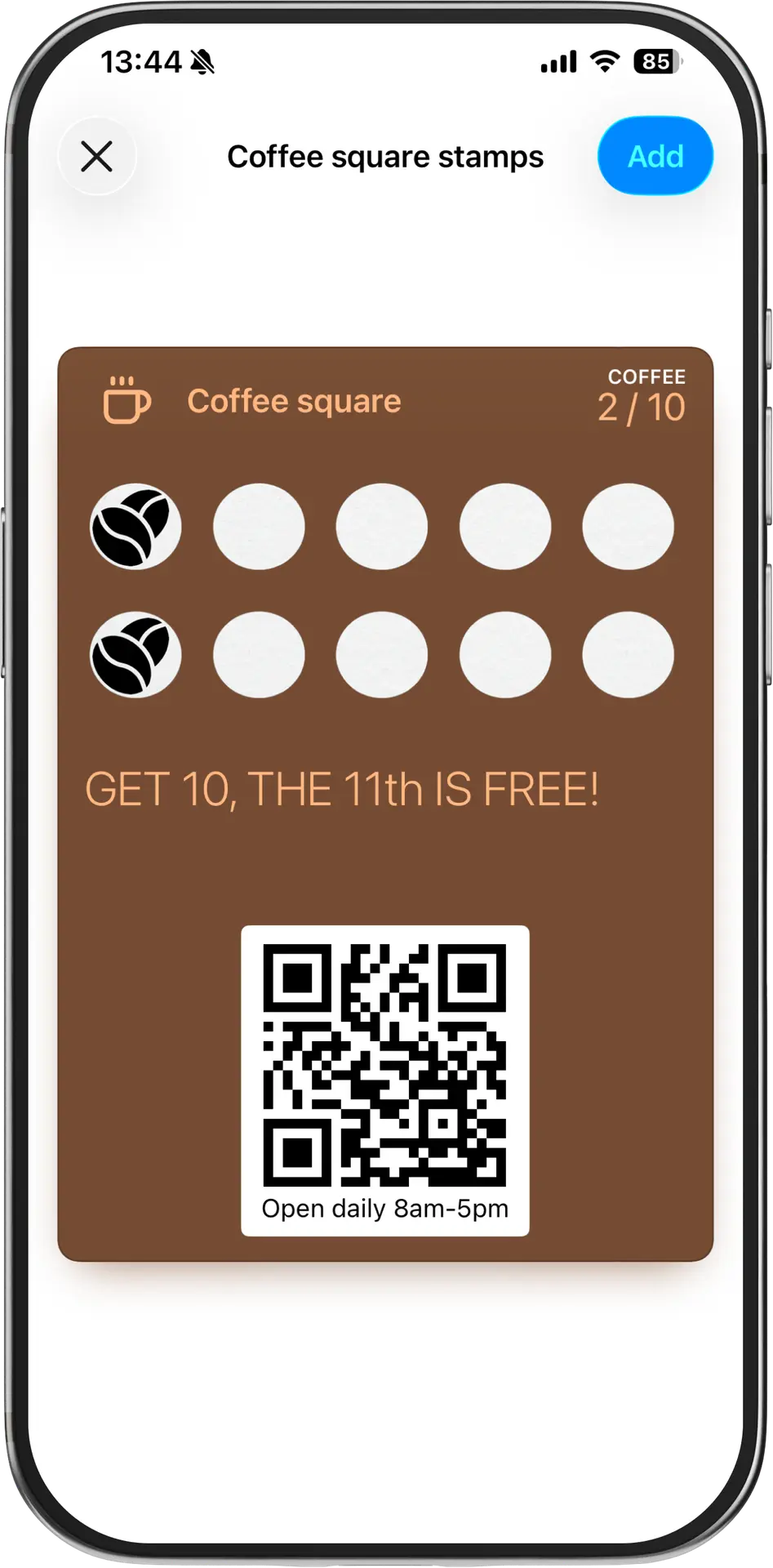
Sushi service runs at two speeds — a fast lunch counter and a slower evening room — and the card fits both without getting in the way. At lunch it keeps pace with the queue; in the evening it’s a half-second between courses. Nothing about your existing till or POS changes: the card sits alongside it, the stamp happens on a phone, separate from the order. A new hire can run it on their first shift, because there’s only one thing to do — tap once when the customer pays.
Questions from the sushi counter.
Straight answers, no marketing fluff.