Digital stamp cards for restaurants — and when a restaurant shouldn’t use one.
“Restaurant” covers a pizza counter doing forty tickets an hour and a sit-down place where one table runs three hours and four courses. The same loyalty card can’t fit both. This page sorts out which model fits your room — stamp card or points — before you build anything. Cards live in Apple Wallet and Google Wallet. No app for your customers to download.
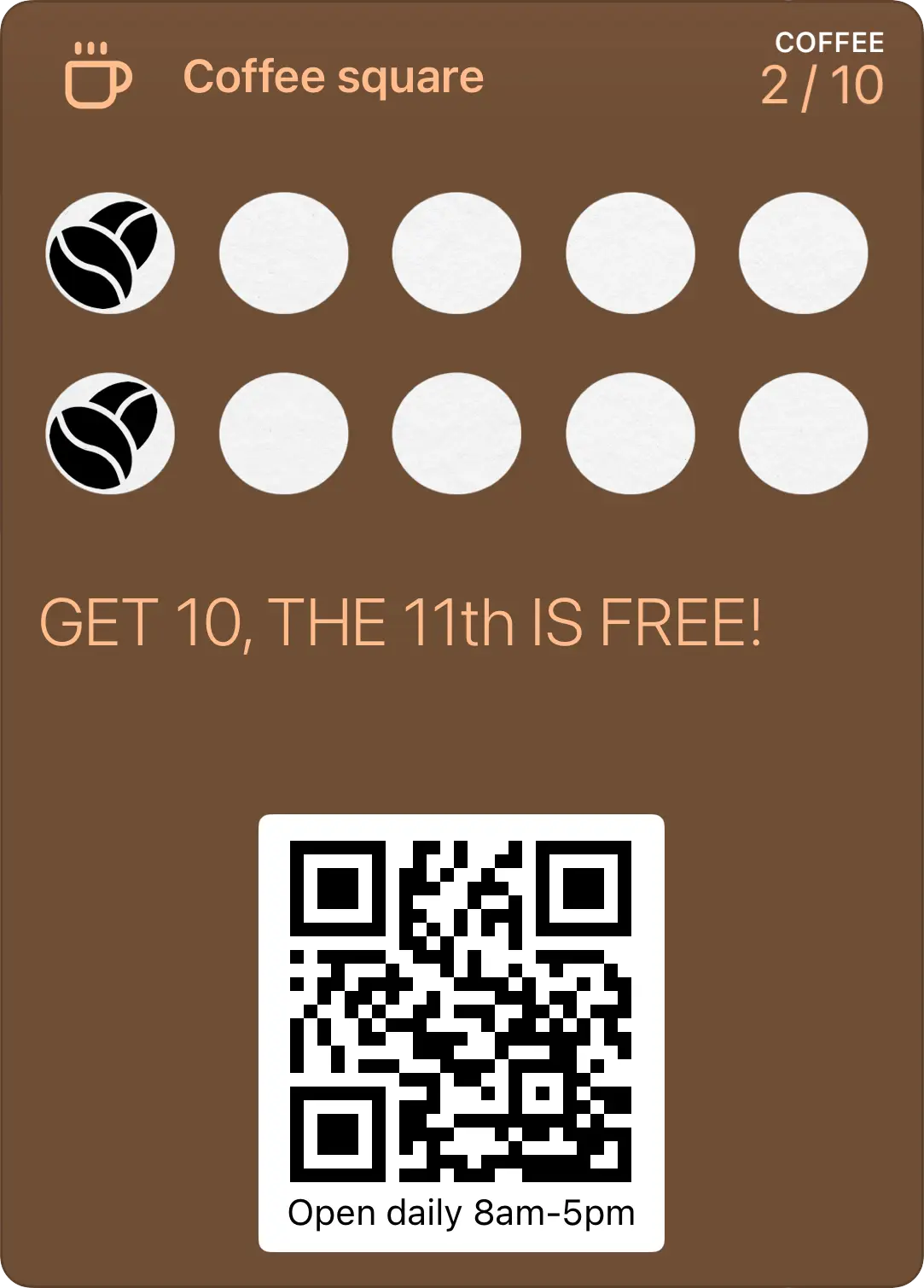


Stamps or points? Two questions decide it.
Most loyalty pitches skip this part. They show you a stamp card, tell you regulars love stamps, and let you find out the hard way that stamps make no sense for a place where one guest spends €12 and the next spends €90.
Two things about your restaurant decide whether a stamp card fits:
How often the same person comes back. A lunch spot sees the same faces every week. A celebration-dinner restaurant sees them on birthdays. High frequency rewards a stamp card; low frequency starves it — nobody fills a card they touch twice a year.
How consistent the check is. A stamp rewards the visit, not the spend. That’s fair when every visit costs about the same — a slice and a drink, a bowl of ramen, a burrito. It quietly punishes you when checks swing wide: the guest who orders a starter, two mains, a bottle of wine, and dessert earns the same single stamp as the one who had a bowl of soup. On a variable check, a stamp card leaves money on the table.
Put those two axes together and most restaurants sort cleanly:
| Your room | Visit frequency | Check consistency | Fits best |
|---|---|---|---|
| Pizza counter / by-the-slice | High | Tight (sub-15) | Stamp card |
| Lunch / fast-casual | High | Tight | Stamp card |
| Ramen / noodle bar | High | Tight | Stamp card |
| Sushi counter (casual) | Medium–high | Tight–medium | Stamp card |
| Taco / burrito | High | Tight | Stamp card |
| Casual full-service | Medium | Wide | Points per spend |
| Celebration / fine dining | Low | Wide | Points or a milestone perk |
If you land in the top block, a stamp card is the right tool and the rest of this page is for you. If you land in the bottom two rows, keep reading — there’s a section below on why points fit you better, and the product does points too.
Pick one option from each row to see the recommendation. The table above answers the same question without JavaScript.
The restaurants stamp cards were built for.
These share two traits: people come back inside the same week, and the check barely moves between visits. That’s the whole recipe.
Pizza
A by-the-slice or one-pie-per-person place runs on regulars who don’t think twice about the order. Ten visits, eleventh pie free — the math is legible to a customer the second they see the card. The trap to avoid: counting large catering orders as a single stamp. Stamp the walk-in habit, not the once-a-quarter party order.
Lunch / fast-casual
The office-district salad bar, the bowl place, the counter where the line forms at 12:15. Same people, same window, same spend, four days a week. A stamp card here isn’t a nice-to-have — it’s the difference between a customer rotating through five lunch spots and settling on yours because they’re four stamps deep.
Ramen / noodle bar
A bowl is a bowl. Tickets cluster in a tight band, the format invites a weekly habit, and the reward (a free bowl, an extra topping) is cheap to give and easy to want. One of the cleanest stamp fits in food, on par with coffee.
Sushi counter (casual)
The conveyor-belt and quick-counter end, not the omakase tasting menu. Casual sushi runs frequent enough and consistent enough for a stamp card. The tasting-menu room does not — that’s a points or milestone room, and it’s covered below.
Taco / burrito
Fast, cheap, repeatable, and habit-forming in the same way coffee is. A burrito-a-week regular fills a card without ever feeling like they’re chasing one. Stamp the build-your-own ticket; it lands in the same narrow range every time.
If your checks swing wide, points fit better than stamps.
Here’s the part the stamp-card sellers leave out.
A stamp card treats a €15 visit and a €90 visit as the same event. For a casual full-service room — shared plates, a couple of drinks, a dessert sometimes and not others — that’s a poor match. The guest who spends the most earns no more than the guest who spends the least, and over a year that gap is real money you didn’t reward.
Stamps can still work in a full-service room — a “five visits, free dessert” card is simple and some regulars love it. But if the check moves around a lot, points per spend usually does more for you: the bigger the table, the bigger the reward, which is the behavior you want to encourage anyway.
The product does both. If you’ve read the diagnostic and landed on the variable-check side, the loyalty card that fits you is points-based, not a stamp card.
No upsell, no “but stamps are more fun.” If points fit your room, use points.
The paper card problem, in a busy room.
- Lives in a wallet, never on the customer at the counter
- Staff stamp the wrong box during a rush
- Card #4 got washed with a pair of jeans
- You learn nothing — no who, no when
- Lives in Apple / Google Wallet — same phone they pay with
- One tap on staff’s phone, no double-stamps
- Boarding-pass territory — never lost
- Visit frequency and last-seen, quietly in the background
The paper stamp card works until the room gets busy, and a busy room is the whole point.
Cards live in a wallet, a coat pocket, the bottom of a bag — never on the customer when they’re at your counter. Staff stamp the wrong box during a rush. A regular who’s been coming for months has nothing to show for it because card number four got washed with a pair of jeans. And you learn nothing: paper tells you a reward was claimed, never who claimed it or when they last came in.
A card in Apple Wallet or Google Wallet is on the same phone the customer already has out to pay. It can’t be lost, it can’t be double-stamped by a distracted hand, and it tells you — quietly, in the background — who your regulars are and when they last walked in. (See how Apple Wallet cards work and Google Wallet.)
What this looks like during a lunch rush.
The fear with any new system is that it slows the line. This doesn’t touch the line.
One scan to enrol
A QR at the table, by the till, on a sticker by the door. Customer taps Add to Wallet, done.
One tap to stamp
Staff opens the app on the phone they already carry. One tap, stamp added.
No POS, no hardware
Nothing wired to the till. Nothing to charge. New hires can run it on shift one.
The customer scans a QR code once to add the card — at the table, by the till, on a sticker by the door. After that, adding a stamp is one tap on a phone or tablet your staff already hold. No POS integration, no new hardware on the counter, no login mid-rush. A new hire can run it on their first shift without a training session.
If you’ve run a paper punch card, this is the same gesture with none of the paper.
A message that lands on the right phone, sometimes.
Your free bowl is waiting. Until close tonight.
Every card you issue is a way to reach that customer later — a notification to their phone, no email address, no app, no ad spend. A slow Tuesday, a new seasonal dish, a “your free bowl is waiting.”
Used sparingly, it brings people back. Used constantly, it gets your card deleted. The card is also location-aware: a message can be set to surface when a regular is near the restaurant rather than at random. Treat it like a tap on the shoulder, not a megaphone.
A good push
- A new seasonal dish, once, with a photo.
- A slow Tuesday afternoon — “your free bowl is waiting until close.”
- A regular who hasn’t been in for three weeks. One nudge, then nothing.
- Location-aware: surface when a regular is near the restaurant, not at random.
Where to be careful
- Anything generic. “Come grab a bite!” reads as noise.
- Peak hours when regulars are already coming in.
- More than once a week as a rough ceiling. The card lives next to their boarding passes — treat it that way.
Setup takes about five minutes.
You design the card — your logo, your colours, your reward — pick stamps or points, and you’re issuing cards the same afternoon. No POS integration, no hardware, no contract. Free for two months with the code START2, then a flat monthly price — one price, every feature, unlimited cards. You’re not billed per customer or per stamp, so a card filling up never costs you more. (see pricing.)
The card data — who your regulars are, when they last came in — is yours. It’s hosted in the EU under GDPR, on European infrastructure. For a restaurant collecting customer contact through a loyalty card, where that data lives is worth knowing before you start.
Questions restaurant owners actually ask.
Straight answers, no marketing fluff.